


 Economic Bundle
 Starter Pack
 Games for Brands
 Games for Portals
 Download Catalog
How to Increase the Revenue of Your Game Portal?
Feb 07 2026
How to Increase the Revenue of Your Game Portal?
Feb 09 2026
Publishing games alone does not keep a game portal alive — nor does it guarantee profitability.
To remain engaging and generate sustainable revenue, a game portal must be actively managed with the right strategy, data-driven decisions, and continuous improvements.A successful portal goes beyond content quantity. It requires the right games, a smooth user experience, regular updates, and a balanced monetization approach.
Level Up Your Game Portal with Our Solutions!
In this article, I’ll walk through the key principles that help transform a game portal into a dynamic and profitable platform.
Table of Contents:
Here are 5 key strategies to boost your portal’s revenue 👇
1- Build an Effective Game Portal
The first thing users experience is your game platform, so it should feel clear, well-structured, and easy to navigate.
A successful game portal is not just a collection of titles — it’s a well-designed platform that delivers smooth navigation, fast performance, and meaningful interaction between players and the system.
Below are the core pillars that help shape an engaging and revenue-driven portal experience:

Smart Categorization & Clean Navigation
Clear and intuitive navigation is the foundation of every good game portal.
When players can easily find what they’re looking for, they stay longer and explore more.
Categorize games by genre, popularity, difficulty, or recency (e.g., Top Played, Puzzle Games, New Releases، Recently Played) and avoid clutter. You should keep menus clean and simple.
Good navigation and categorization directly improve user retention and help users naturally discover more games.
User-Friendly & Responsive UI/UX
A portal should feel consistent and enjoyable across all devices — mobile, tablet, and desktop. To design a suitable UI for your portal, you should know who your users are, and for whom you publish the games: kids, adults, seniors, women, etc. Also, it’s essential to know about your audience’s devices.
Important considerations:
- Ensure full responsiveness so users on smaller screens have the same quality experience as desktop players.
- Use a clean interface with readable elements and simple interactions.
- Use layouts that guide the eye clearly without overwhelming the user.
Increase your game portal revenue with a personalized, high-performing UI design. A user-friendly interface keeps players active longer, directly contributing to higher revenue.
Player Feedback & Bug Reporting System
A great portal should have an upgrade plan that can be implemented at any time, based on player feedback. It’s essential for a lively, zestful game portal.
Providing an easy way for users to report issues builds trust and helps improve game quality.
Why it matters:
- Players can quickly report bugs or gameplay issues.
- Developers receive clear information for faster fixes, and the plan will be clear.
- It prevents minor problems from turning into user drop-offs.
- Players who feel heard are more engaged and far more likely to return.
This system keeps both the portal and its games healthy in the long term.
Intelligent & Personalized Recommendations
Consider a system that suggests games and content based on user behavior, preferences, and basic demographics. When players feel that the portal understands their interests, discovery becomes easier and more enjoyable.
Personalized recommendations create a sense of ownership and relevance (the portal was made for them). This kind of experience significantly increases engagement, repeat visits, and long-term loyalty, turning casual players into returning users.
Everything You Need to Boost Your Game Portal!
We have over 100 games ready to publish on your portal, as well as a full suite of services that can feature your logo in the games, reskin them to match your brand, and integrate your API/SDK.
Explore What We Offer!2- Publish the Right Games
Game selection is the most critical factor in building a successful game portal. Don’t forget the goal is to create a stable, dynamic platform that generates consistent engagement and sustainable revenue—not simply to publish as many games as possible.
A data-driven approach is essential. Publishing large volumes of low-impact games rarely delivers results. Instead, games should be released strategically, with close attention to user behavior and market signals.
To achieve this, consider the following key factors:
Understand Player Interests
Before selecting or publishing any game, the first step is understanding your audience. Player interests are often shaped by factors such as age, preferences, and behavior.
Knowing who your users are helps you identify which genres — racing, puzzle, casual, or others — are most likely to resonate with them.
Game selection should always reflect your target audience. The more insight you have into your users’ needs and play patterns, the better you can publish games that meet their expectations, leading to higher engagement and stronger retention.
Analyze Playtime, Player Volume, and Retention
Playtime alone doesn’t tell the full story. To understand whether a game or genre is truly successful, you need to look at a combination of key metrics.
High playtime usually indicates strong engagement — players are willing to stay longer because the gameplay is enjoyable.
But player volume also matters. A game played by many users, with frequent sessions, shows broader appeal and stronger demand.
Another critical signal is retention. Games that bring players back multiple times prove that the experience remains interesting beyond the first session. High retention often reflects good balance, replay value, and satisfying progression.
When a specific game or genre consistently shows strong playtime, high player numbers, and solid retention, it’s a clear indicator of success. Publishing similar games — with different gameplay, mechanics, themes, or visual styles — is more likely to perform well and directly contributes to stronger portal revenue.
Use Market Data & Study Competitors
Staying relevant requires continuous market observation. Game portals need to track which games and genres are trending, how player preferences evolve, and what types of content competitors rely on to drive engagement.

Platforms such as Poki, CrazyGames, and GameMonetize offer a surface-level view of what’s currently performing well. For deeper insights, tools like AppMagic help analyze market trends, genre performance, and long-term popularity across different platforms.
A key question to ask is: What types of games do successful portals consistently publish?
The answer usually falls into two categories:
- Trending games, which capture current player interest and help attract new users.
- Evergreen games, which maintain steady demand over long periods and rarely lose relevance.
Evergreen titles such as Sudoku, Bubble Shooter, Solitaire, Match-3, and Tap-to-Blast have proven their value over time. These games continuously generate engagement and provide stability, while trend-driven games bring freshness and growth.
By combining both approaches—following market trends and understanding competitors’ strategies—portals can stay up to date, reduce risk, retain existing users, and consistently attract new audiences.
The goal is to publish high-performance games that match user interests, not just a large number of games.
Fast, smooth performance: Quick load times and stable gameplay increase retention. Select games with optimized code and low file size.
3- Build a Smart In-Game Economy
A healthy in-game economy is one of the strongest foundations of a successful game.
It defines how players progress, what motivates them to return, and how the game ultimately generates revenue.
Even a great game with strong playtime can fail financially if its economy is unbalanced or poorly structured.
A well-designed game economy should feel fair, rewarding, and engaging — while still supporting sustainable monetization. To achieve this balance, several principles matter:
Create a Clear and Balanced Progression System
A good progression system keeps players motivated by giving them a sense of steady growth — through levels, XP, upgrades, or unlockable content. But progression only works when it’s balanced.
If the game becomes too easy, players lose interest after a few stages because there’s no real challenge. If it becomes too hard, many will stop playing altogether.
To maintain engagement, some games introduce difficulty spikes, slightly harder levels that appear every few stages, to keep players alert and motivated without overwhelming them.
A well-balanced progression curve ensures players always feel challenged, but never stopped, and this balance directly supports long-term retention and a healthier in-game economy.
Balance Difficulty and Rewards
If rewards are too easy, the game loses the challenge. If it’s too hard, players quit early. A balanced reward loop keeps players returning and creates natural opportunities for monetization (ads or purchases).
You need to know which stage and position users have progressed to in the game, and at what stage they have exited. This will help you retain users by offering the appropriate reward (coins, time, etc.) when they stop due to gameplay difficulty.
Maintain a Stable Currency System
If your game uses coins, gems, or energy, make sure earnings and spending are balanced:
- Avoid inflation (too many rewards): One of the most common mistakes is to give players too many rewards. When coins become easy to earn, items lose their value, and progression feels meaningless.
- Avoid scarcity (too few opportunities): On the other hand, scarcity can be just as damaging. If players don’t earn enough currency to advance, they hit a wall and quickly lose motivation.
Both problems break the game’s economy and reduce long-term engagement.
A simple example: when a player fails several times, you can slightly increase the coin reward to keep them motivated — but the bonus must stay controlled. Too much creates inflation; too little creates frustration.
A balanced currency system keeps the game engaging and supports long-term retention.
Monitor Key Metrics for Economic Health
Understanding whether your in-game economy is working requires more than looking at revenue. You need to see how players interact with the game and how their behavior shifts over time.
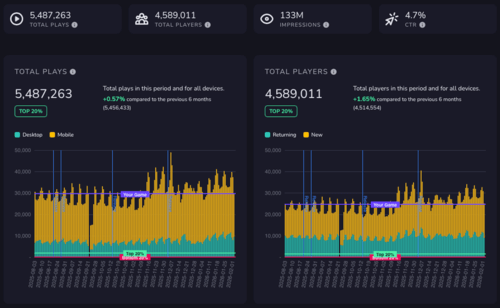
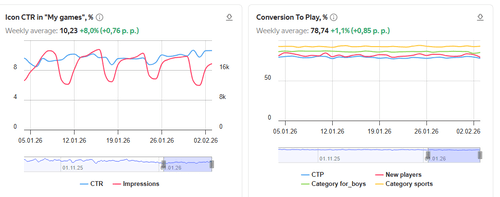
Metrics like retention, eCPM, session length, and conversion rate reveal whether your progression, rewards, and monetization feel balanced.
To track these patterns, analytics tools such as GameAnalytics can be integrated into your games.
They show exactly where players drop off, how often they return, which levels create frustration, and where they choose to watch rewarded ads or make purchases.
By studying these signals, you can spot early signs of economic imbalance — whether the game becomes too easy, too hard, too slow, or too dependent on ads.
Regularly analyzing these metrics helps you understand how changes in your economy affect real player behavior, allowing you to optimize without damaging the user experience.
Turn Your Game Portal into a Revenue Engine!
Launch 100+ proven games optimized for ads and long-term engagement. Customize visuals, add your logo, and integrate seamlessly.
Browse Our Offerings!4- In-Game Content & Updates
Fresh in-game content is one of the most effective ways to keep a game alive.
In-game content refers to everything within the game that gives players new experiences. These additions prevent the game from feeling repetitive and help maintain the balance between challenge and engagement.
When players feel that every login offers something different, they stay motivated and return more often. That’s why regularly updating your game with meaningful content is essential for long-term retention.
To keep the experience fresh, you can:
- Add new levels or game modes from time to time
- Introduce weekly challenges or seasonal events
- Update graphics, UI, or sound based on player feedback
- Release new items, skins, or small features over time
- Refresh marketing assets (videos, icons, banners, screenshots) to match the latest updates
Consistent updates show players that the game is evolving, which naturally leads to higher engagement, longer play sessions, and stronger overall performance.
If you want your game to have a long life, don’t neglect the In-Game content strategy.
2 Successful Examples
Some of the most successful games in the world owe their longevity to consistent, meaningful content updates.
Candy Crush
A clear example is Candy Crush Saga, which has remained relevant for more than a decade.
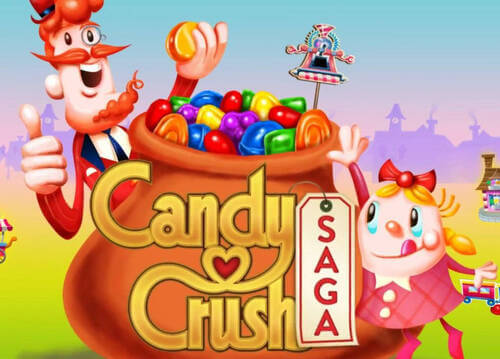
The game constantly introduces new levels, special events, limited-time challenges, and seasonal themes — giving players a steady stream of fresh experiences.
This rhythm of updates prevents the gameplay from feeling repetitive and keeps both new and returning players engaged.
Royal Kingdom
Another strong example is Royal Kingdom, a game that regularly adds new cards, arenas, balance changes, and event modes.

These updates not only refresh the gameplay but also reshape the in-game strategy, making the experience feel dynamic and unpredictable. Players return not just to play, but to see what’s new.
These games demonstrate how powerful in-game content can be. When players sense that a game is evolving, they stay curious, engaged, and far more likely to keep coming back.
5- Optimizing Ad Placement
Ad placement is one of the strongest revenue drivers for game portals.
When done correctly, it boosts income without hurting user experience — but poor placement can easily frustrate players and reduce retention.
The goal is to balance monetization with enjoyable gameplay.
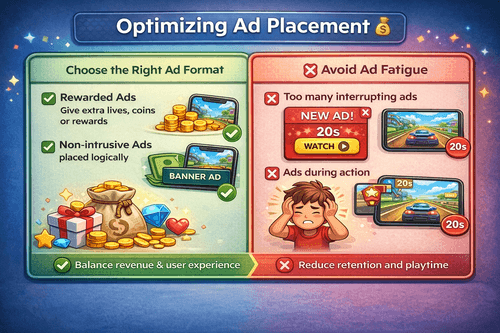
Choose the Right Ad Format for Each Game
Different games require different ad formats:
- Rewarded Ads work best in games with long progression or upgrade systems.
- Interstitial Ads fit short, level-based games (especially after winning or losing a level).
- Banner Ads provide steady revenue when placed in non-intrusive areas of the UI.
- Matching the ad format to the game’s design is essential for maximizing performance.
Avoid Ad Fatigue
Too many ads reduce retention and session time, and they can churn your users. Users that you spent to achieve them.
Pay attention to the best practices:
- Not showing ads during action
- Limiting the number of ads per session
- Keeping logical spacing between each ad
Don’t forget that less intrusive ads lead to more long-term revenue. Players simply won’t spend much time watching ads. Ignoring this can become costly for any game portal.
Use the Right Timing
Great timing increases both user tolerance and revenue. Try to show ads for a justifiable reason. It’s essential for maintaining users.
High-performing placement moments include:
- After completing a level
- When the player needs an item or boost (Rewarded Ads)
- At the end of a challenge or attempt
- When returning to the main menu
- When a user loses
Ads shown at “natural breaks” feel smoother and more acceptable.
Run A/B Tests Regularly
There’s no single “perfect” ad setup that works for every portal. Player behavior changes from game to game, and even small interface differences can affect the results.
That’s why running A/B tests is essential.
By testing different timings, frequencies, and formats, you can quickly see what actually resonates with your players — not what you assume will work.
In many cases, adjusting something as small as the moment an ad appears can noticeably increase overall revenue.
Final Thoughts
Managing and growing a successful game portal involves many moving parts. From technical performance and user experience to content strategy and monetization, there are countless details that can influence long-term success.
That said, the points covered in this article represent what I believe are the most critical foundations. When game selection is data-driven, the portal experience is smooth, content is updated consistently, and the in-game economy is well-balanced; everything else becomes easier to optimize.
If you’d like to explore these topics in more depth, feel free to follow my LinkedIn newsletter and visit our blog, where we regularly share insights, strategies, and practical lessons from the game portal and HTML5 gaming space.
We’re always working to help businesses grow their platforms, improve performance, and solve real-world challenges more effectively.
Everything You Need to Boost Your Game Portal!
We have over 100 games ready to publish on your portal, as well as a full suite of services that can feature your logo in the games, reskin them to match your brand, and integrate your API/SDK.
Explore What We Offer!